Multi-factor authentication solutions
OneSpan delivers the industry’s most established portfolio of multi‑factor authentication solutions – trusted by banks, enterprises, and governments worldwide.
With 30+ years of experience, OneSpan helps organizations strengthen access security using proven multi-factor authentication methods. Our solutions use both software and hardware devices to support a wide range of use cases, from large‑scale customer authentication to workforce access in regulated environments.

What is multi-factor authentication?
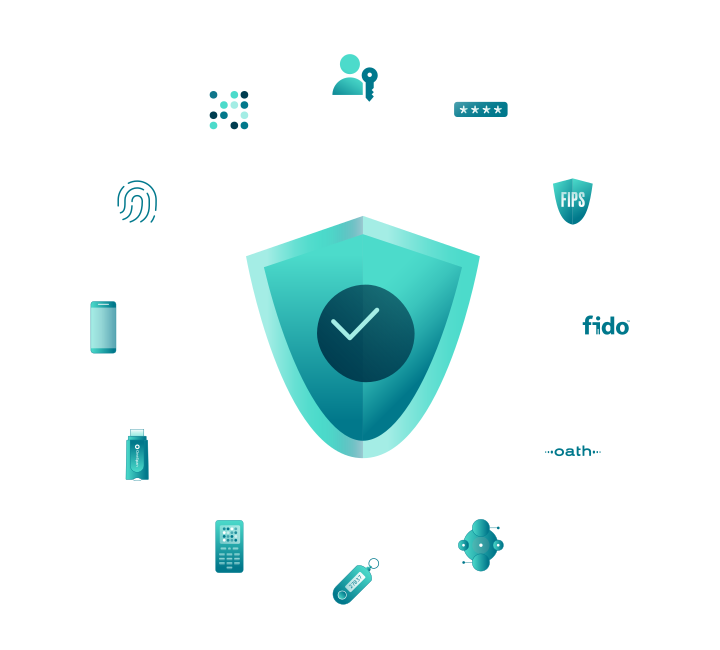
Multi‑factor authentication (MFA) strengthens security by requiring users to verify their identity using two or more independent factors before accessing an application, service, or transaction. By combining different verification methods, MFA reduces the risk of unauthorized access compared to relying on a single credential.
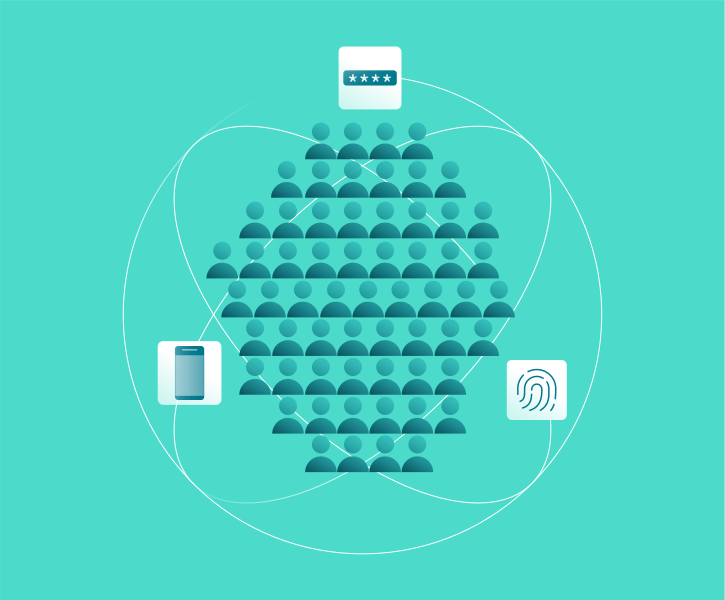
Authentication factors typically include:
- Something you know, such as a password or PIN
- Something you have, such as a mobile device, authenticator app, or hardware token
- Something you are through a biometric scan, such as facial recognition or a fingerprint
Organizations can implement MFA using a range of methods and technologies based on their industry’s risk, regulation, and use context.
Looking for passwordless authentication options?
MFA security solutions for compliance-driven environments
No other vendor matches our adaptability, future-proofing, and range of options.
OneSpan supports secure, auditable access at scale for customers, employees, and partners.
Aligned with key regulations and standards-based requirements - including PSD2, NIS2, GDPR, FIPS, and NIST guidance, among others - global banks and regulated enterprises worldwide trust OneSpan for their MFA needs.
MFA for real-world environments
Real‑world authentication isn’t one‑size‑fits‑all. Organizations must secure different users, channels, and risk levels, without adding friction or operational complexity.
OneSpan’s MFA solutions are designed to support diverse use cases at scale, from customer authentication in regulated industries to workforce login across global environments.
Our expert team is ready to discuss your needs and how OneSpan’s leading, comprehensive authentication suite can help.
A comprehensive suite of authentication solutions

OTP authenticators
- Reduces risk of account takeover and identity misuse
- Improves security beyond passwords and SMS-based authentication
- Scales reliably across large user populations
Mobile authenticators
- Balances security and usability in digital journeys
- Reduces unauthorized access without adding friction
- Supports mobile‑first customer and workforce access
FIDO2 security keys
- Enables passwordless authentication for sensitive access
- Offers phishing‑resistant protection against credential attacks
- Simplifies secure login with hardware‑backed assurance

Transaction data signing devices
- Protects integrity of banking transactions
- Ensures authenticity through transaction‑specific user confirmation
- Reduces fraud risk by preventing manipulation or replay of transaction data
Cronto visual transaction signing devices
- Adapts authentication to transaction risk and context
- Increases trust and reduce fraud with “what you see is what you sign”
- Protects transaction integrity through dynamic linking
Passkeys authentication
- Centralizes authentication policy and decision‑making
- Reduces operational complexity across users, channels, and methods
- Enables controlled evolution of authentication strategies over time
Key customer authentication capabilities


Stronger protection against unauthorized access
- Reduces reliance on a single credential
- Lowers exposure to credential stuffing, brute‑force attempts, and password‑related fraud
- Adds layered security for higher‑risk access and actions
Better user experience
- Provides stronger access protection without unnecessary friction
- Supports authentication methods suited to different users and risk levels
- Encourages broad user adoption through clear and consistent access experiences
Operational efficiency
- Reduces support burden with fewer helpdesk tickets related to forgotten passwords, authentication errors, and account lockouts
- Decreases onboarding friction and ongoing credential administration
- Enables a standardized approach to MFA across applications and environments, supporting efficiency as deployments scale
Compliance and regulatory alignment
- Helps meet strong authentication expectations across PSD2, GDPR, NIST, NIS2, MAS TRM, RBI guidelines, and more
- Reduces reliance on complex password policies and associated risks
- Supports clearer, auditable authentication flows for regulated industries
The benefits

Lower entry costs, immediate value
A predictable subscription model with no initial hardware purchase. Annual replacement of up to 15% of keys is included.

Stronger security, less risk with passwordless
FIDO2‑certified hardware keys eliminate password vulnerabilities and stop phishing‑based credential theft.

Enterprise‑ready compliance & control
FIDO2 security keys enforce strong MFA across distributed, privileged, and hybrid environments, helping organizations meet modern authentication mandates with confidence.

Flexibility across your entire workforce
Support diverse user needs and device types with multiple Digipass® FIDO2 security key form factors, ensuring secure access everywhere work happens.
“With OneSpan’s help, we were able to meet the European Banking Authority's strong customer authentication requirements, while at the same time enhancing security and improving the online and mobile banking experience for our customers.”
Charis Pouangare, Director Consumer & SME Banking, Bank of Cyprus
Frequently asked questions
MFA is a security method that requires users to verify their identity using two or more factors before gaining access. These factors typically combine something the user knows (like a password) with something they have (such as a device or token) or something they are (like a biometric). By adding this extra layer, MFA significantly reduces the risk of unauthorized access.
MFA works by requiring additional verification steps after a user enters their primary credentials. For example, the user may be asked to enter a one-time code from an authenticator app, approve a login via mobile device, or use a hardware token. Access is only granted once all required factors are successfully validated, ensuring stronger identity assurance.
MFA solutions support a range of authentication methods to suit different use cases, including one-time passwords (OTP) via mobile apps or hardware tokens, push-based authentication, transaction signing devices, hardware security keys, and passkeys. Passkeys are a passwordless authentication method based on public-key cryptography. They can be used across devices, with hardware security keys providing a high-assurance, phishing-resistant way to use them.
Organizations can combine these methods to balance security, user experience, and operational requirements across different user groups.
Businesses should select MFA methods based on their security requirements, user profiles, and regulatory obligations. Factors such as phishing resistance, user experience, deployment complexity, and cost all play a role.
For example, passkeys and hardware-based methods provide strong protection against phishing, while OTP-based approaches may be easier to deploy across large user bases. In practice, many organizations adopt a combination of methods to balance security and usability.
Organizations should implement MFA whenever sensitive data, systems, or transactions need to be protected. This includes workforce access to corporate applications, remote access (VPN), and customer-facing platforms such as online banking or digital services. MFA is also commonly required to meet regulatory and compliance standards in many industries.
MFA helps organizations meet regulatory requirements by strengthening identity verification and access control. Many standards and regulations, including those in finance and healthcare, require strong authentication for accessing sensitive data or performing high-risk transactions. Implementing MFA demonstrates a proactive approach to security and helps reduce the risk of breaches and non-compliance.
Modern MFA solutions are designed to integrate with a wide range of applications, including cloud services, on-premises systems, and custom environments. Integration can be achieved through standard protocols, APIs, or identity platforms, enabling organizations to enforce consistent authentication policies across their entire digital ecosystem without disrupting user workflows.
MFA strengthens account security by adding an additional layer of verification beyond passwords. Even if one factor is compromised, unauthorized access is significantly harder without the second factor. By combining multiple authentication methods, organizations can reduce the risk of account takeover and better protect sensitive data, systems, and transactions.
Ready to secure your organization through MFA?