Four ways financial services can build trust into digital agreements
When financial services institutions first adopted eSignature, the goal was often straightforward: Digitize paper processes. That first wave of digitization created real value. It reduced manual work, accelerated customer onboarding, and helped financial institutions move more business into digital channels.
But the role of eSignature has changed.
In highly regulated industries, eSignature has evolved to play a critical role in proving the integrity, authenticity, and trustworthiness of transactions.
For banks, insurers, wealth management firms, and lenders, transaction trust starts with answering fundamental questions, including:
- Can we prove who signed?
- Can we prove when and how they signed?
- Can we verify that the document was not changed?
- Can we defend the transaction in an audit or dispute?
- Can we create a digital experience that customers recognize and trust?
- Can we modernize our workflows as our business, regulations, and security threats continue to evolve?
These are the areas where many financial services institutions are beginning to realize their current eSignature provider may no longer meet their needs.
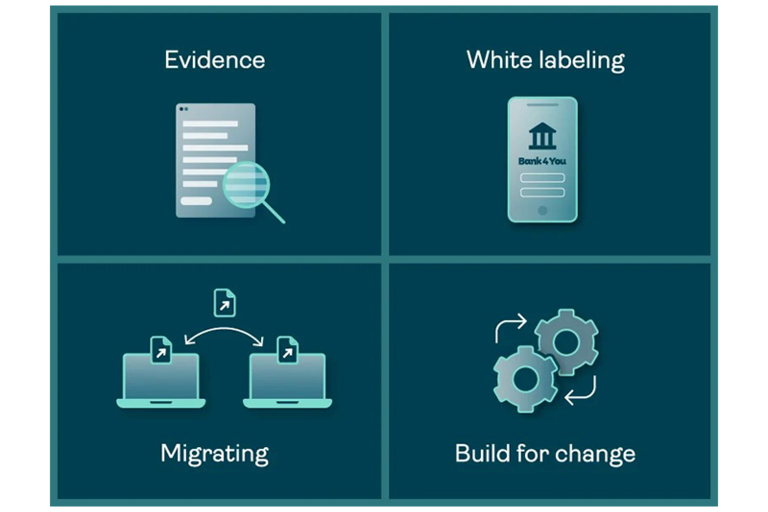
From my work with regulated businesses around the world, I believe four factors should sit at the center of every eSignature strategy:
- 1. Defensible evidence
- 2. Trusted white-labeled experiences
- 3. Migrations for modernization
- 4. A build-for-change mindset
Evidence is the foundation of regulatory compliance
In financial services, compliance issues often do not appear during day-to-day usage. For example, your eSignature platform may seem to be working well — documents are being sent, customers are signing, transactions are moving through the system. But then an audit happens, or a dispute arises, or a regulator asks for proof.
Evidence allows you to reconstruct what happened during these day-to-day digital transactions. It helps you answer the questions that matter:
- Who signed
- What actions they took
- How identity was verified
- What documents were presented
- When each event occurred
- Whether the final agreement was altered
That evidence needs to be clear, complete, and independently verifiable. Evidence also needs to be connected to the agreement itself in a way that is easy to defend.
Some platforms separate evidence from the document. If you have to go to one place to download the agreement, another place to find the transaction summary, and another system to validate identity or audit information, you introduce risk.
However, it’s important to note that although technology can enable compliance, it does not remove accountability. That is why I advise institutions to look beyond basic compliance claims. For example, understand how evidence is captured and where it’s stored. Is the eSignature provider also able to connect identity assurance to the transaction and can you easily defend the transaction?
Regulators look at whether your process met the required standard, whether the appropriate controls were in place, and whether the transaction can be defended. If you make evidence central to your eSignature evaluation, you won’t need to worry.
It’s important for financial institutions to have a clear, complete, defensible record of the agreement and the evidence behind it.
White labeling is a critical security measure
White labeling is often misunderstood. Many organizations think of it as a branding feature to make the signing experience look more polished or consistent with their corporate identity.
While that is true, it’s only part of the story. White labeling is also a security measure, and is particularly important in high-risk and high-assurance industries like financial services.
Attackers often impersonate large technology providers because those brands are familiar. If a customer receives an email that appears to come from a widely known eSignature or technology platform, they may click without thinking carefully. The attacker benefits from the trust that already exists around that third-party brand.
But when a financial institution brings the customer into its own branded signing experience, the trust model changes. The customer recognizes the institution and their relationship with it. Trust is immediately established for the eSignature transaction, because it’s in the context of the brand they already know.
A fully branded, white-labeled experience helps reinforce that the transaction is coming from the institution, not an unrelated third-party technology provider. It gives customers a familiar environment and removes confusion.
For financial services institutions, this is especially important because the transactions involve sensitive information and often the movement of funds. Customers may be opening accounts, applying for loans, signing investment documents, updating policies, or completing other high-value workflows, so the digital experience must feel secure, familiar, and trustworthy.
White labeling also supports a stronger approach to identity assurance. When customers interact with your brand, they may better understand why additional verification is being requested, and therefore be more willing to complete identity verification because it is connected to a relationship they trust.
Security, cost, and user convenience must always be balanced. But in today’s environment, customers increasingly expect security, especially when financial or personal information is involved.
For this reason, white labeling and identity assurance should not be treated as separate decisions. Instead, you should evaluate white labeling as part of your eSignature security strategy. Together, they help create a digital agreement experience that is recognizable, secure, and defensible.
White labeling is a key security feature for financial institutions that helps to build customer trust.
Migration is an opportunity to modernize
Migration is one of the biggest concerns I hear from organizations considering a new eSignature provider. Many teams worry that moving from one platform to another will be disruptive. They worry about operational risk, implementation timelines, historical documents, customer experience, integrations, and internal adoption.
But migration does not have to be a reason to stay stuck with a solution that no longer meets your needs.
With the right partner, methodology, and technical support, the electronic signature migration can be structured, manageable, and far less risky than many organizations expect. More importantly, migration can be an opportunity to modernize.
This is where I encourage institutions to shift their thinking.
Too often, organizations approach migration with one goal: Recreate the old process in a new platform as quickly as possible. That is understandable. When teams feel pressure to move quickly, the instinct is to make the new system look and behave like the old one. That can be a missed opportunity.
If your existing workflows are outdated, overly complex, difficult to maintain, or not aligned with current security and regulatory needs, you do not want to simply replicate those same limitations in a new environment.
Migration is the moment to ask better questions, such as:
- What are we trying to achieve?
- Which workflows should be simplified?
- Where do we have unnecessary technical debt?
- Where do we need stronger identity assurance?
- Which integrations need to be modernized?
- Which processes were designed for yesterday’s business model?
- What will we need this platform to support in the next 3-5 years?
A strong migration process should help you preserve what matters, reduce operational risk, and improve the workflows that need to evolve.
Keep in mind, digital workflows should remove unnecessary complexity. They should improve the user experience and make integrations easier to maintain while allowing you to scale into new use cases without rebuilding everything from scratch.
A workflow that was sufficient five years ago may not be flexible enough for today’s environment. AI, identity verification, customer expectations, regulatory changes, and new digital channels are all reshaping how agreements are created, executed, and defended.
Your eSignature solution needs to be ready for that change.
Don’t think of an eSignature migration as a one-time technical project. Think of migration as a business modernization opportunity for more secure and scalable digital agreement workflows.
Migration from your legacy eSignature solution to a new partner is the key to modernizing digital agreement workflows and may be easier than you realize.
A build-for-change mindset helps you evolve over time
If there is one piece of guidance I would leave with financial services leaders, it’s to build for change.
The digital agreement landscape is evolving quickly. AI is accelerating faster than many expected. Identity expectations are changing. Phishing threats are growing more sophisticated. Regulatory scrutiny is increasing. Customers expect secure, simple, and familiar digital experiences.
Your eSignature platform needs to adapt to a constantly changing technical landscape.
Look for modular architecture and easy-to-use APIs. Ensure you can deploy flexible identity options with eSignature evidence that is complete and defensible. Build a partnership with your provider that understands financial services and can help you evolve over time.
For financial services institutions, eSignature workflows are a critical part of how you establish trust, manage risk, serve customers, and defend digital transactions.
Build for change, because the eSignature decisions you make today must support the risks, expectations, and innovations of tomorrow.
How to evaluate if your eSignature provider is built for financial services
If you are evaluating your current eSignature provider, I would encourage you to focus on three practical questions that will tell you a lot about whether your current solution is built for where the financial services industry is headed.
- 1. Can we defend every transaction with complete, clear, and verifiable evidence?
- 2. Does our signing experience reinforce customer trust and reduce security risk through white labeling and appropriate identity assurance?
- 3. Are we using migration or platform evaluation as an opportunity to modernize, or are we simply recreating old workflows in a new system?
On-demand webinar
Top reasons financial institutions switch eSignature providers
Hear more guidance on evaluating eSignature providers.
Watch now